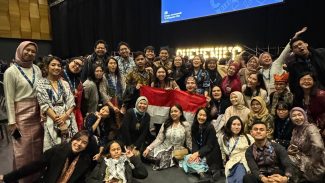
How Chevening alumni are connecting a network in Indonesia
Discover how the Chevening Alumni Association of Indonesia is connecting 2,000 alumni to create opportunities, support communities and drive impact.
Discover how Chevening alumnus Mohammad Naciri’s time at Oxford shaped his international career advancing gender equality and women’s rights as Chief of Staff at UN Women.
In 1999, Mohammad Naciri was awarded a Chevening Scholarship to study social anthropology at the University of Oxford. Nearly three decades later, he has built a career spanning continents addressing some of the world’s most pressing development and humanitarian challenges. Today, he serves as Chief of Staff at UN Women, the United Nations entity dedicated to gender equality and the empowerment of women.
Mohammad recently returned to the UK, where we had the opportunity to meet him at the Foreign, Commonwealth and Development Office (FCDO) in London.
Sitting beside the Mirror Wall at the FCDO, which was installed in 2018 to inspire young female diplomats to aim for top diplomatic posts, seemed a fitting place to discuss Mohammad’s career advancing women’s rights and gender equality and the lasting impact of his Chevening year.
Growing up in Morocco, Mohammad says he was raised in a household where equality was not seen as an issue. His great-grandfather, a landowner, sent his sons to receive a higher education after the First World War. When he ran out of money to educate his daughters, however, he made an unusual decision for the time: he sold some of his land to ensure they could also study.
It was a gesture that reflected the values Mohammad grew up with, but it was only when he encountered the world beyond his immediate surroundings that he began to recognise how far those values were from the reality experienced by others.
‘Once I left this immediate environment, I discovered that the world is not like this, at least not where I’m from, and that made me angry.’
After completing his undergraduate studies, Mohammad began to question what he wanted his professional life to stand for. He knew he didn’t want to spend his career simply pursuing financial success.
He realised that some of his most meaningful experiences as a student had come from working with children in orphanages and supporting those who needed help, prompting him to pursue a career in development. He approached UNICEF for a list of charities he could work with and found himself with an internship there instead. He stayed for a couple of years before an opportunity to work on a development programme in Egypt, funded by the UK’s Department for International Development (DFID) and delivered through the British Council, introduced him to Chevening.
With the support of Chevening, Mohammad chose to study at Oxford, where he would undertake a master’s degree in social anthropology.
‘At that point in my life, my exposure to the world was more domestic and regional, so [when I arrived in the UK], my whole worldview opened up. I had classmates from every single corner of the world.’
He was equally struck by the openness of the academic environment. Discussions with classmates and lecturers encouraged him to examine development, question established systems, and confront the legacy of colonialism.
‘How can we take ownership and be proud of what we are, yet not be blind to the missteps that we took?’
For Mohammad, this was one of the most important lessons of his Chevening year: learning to think critically while remaining open to other perspectives.
The experience was also defined by the kindness he encountered in the UK. He recalls a fellow student asking whether he was comfortable with her keeping pork in their shared kitchen fridge, taking his religious background into consideration.
‘I said, “of course it is okay,” but I felt in that moment that they really saw me.’
These experiences helped shape his understanding of the importance of empathy and mutual respect, values that would remain relevant throughout his international career.
Chevening also gave Mohammad access to a network of peers that he continues to value today. Nearly 30 years later, he remains in touch with people he met during his studies.
‘Chevening has put me on a path, not smooth sailing, but definitely smoother than the average person who works in development spaces like me who wouldn’t have had the opportunity I did…
‘Chevening allowed me and others who may not have belonged to privileged classes this opportunity.’
Following his studies at Oxford, Mohammad began a career with the UN that has spanned almost 30 years, taking him from Cambodia to Kuwait, Yemen, Egypt, Thailand, and New York.
His early work with the International Organisation for Migration (IOM) in Cambodia focused on human trafficking. He advocated for greater recognition of trafficking in the country and helped secure US government funding for IOM’s work on the issue. His subsequent roles included establishing IOM’s mission in Kuwait, supporting development and gender equality initiatives in Yemen, and taking on senior leadership positions at UN Women.
One particularly significant example of his impact came in Cambodia, where he helped bring attention to the scale of human trafficking and mobilise resources to address it. His advocacy helped secure US$10 million from the US government for IOM’s anti-trafficking work.
His career has since encompassed a wide range of issues, from access to justice and humanitarian response to women’s participation in political processes.
‘I get to make the world a better place and see the world while I’m doing it.’
As Regional Director of UN Women in the Arab States, Mohammad also championed women’s participation in peacebuilding. In Yemen, the regional office supported the convening of 45 women from different political factions to call for a more inclusive peace process. The initiative reflected a wider effort to ensure that women have a meaningful role in shaping their country’s future.
‘Over the past 30 years, there are so many days I wake up disillusioned about how much work we still have to do, but I think how much worse we would be if we didn’t have the UN. That keeps me going.’
For Mohammad, Chevening’s impact extends well beyond the qualification he gained at Oxford. It broadened his worldview, introduced him to relationships that have endured for decades, and helped create opportunities that might otherwise have been out of reach.
He also sees Chevening as an important form of international engagement. Living and studying in the UK gave him a deeper understanding of the country and its people, creating a connection that has lasted throughout his career.
‘I am a friend to the UK for the rest of my life.’
Mohammad believes that educational exchanges can have a lasting diplomatic impact by building relationships between people who share values and go on to work together across borders and institutions.
That connection is something he actively seeks to pass on. Mohammad continues to attend Chevening alumni events, meet new scholars, and offer practical guidance to those preparing to study in the UK. He takes a similar approach in his professional life, making time for younger colleagues and sharing lessons from his own experience.
His message to current and future Chevening scholars is to approach the experience with an open mind and make the most of every opportunity.
‘Be extremely open to what comes your way. It’s a life experience, not just an academic experience. Leave the perceptions and stereotypes you have behind. Come with a new slate. Be ready for the new chapter. Allow yourself to be wowed and use every single day. It’s such a precious moment.’
Discover how the Chevening Alumni Association of Indonesia is connecting 2,000 alumni to create opportunities, support communities and drive impact.
Singapore’s first ASEAN-Chevening Scholar, Danial Hakim, reflects on his Oxford experience, regional cooperation and his hopes for the future of public service in Singapore and ASEAN.
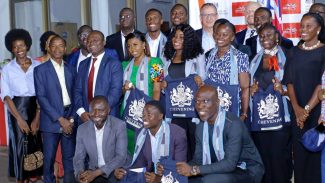
The Ivorian Chevening Association (ICA) are turning their network into a source of support, opportunity, and impact while building connections across West Africa.