


Chevening Southeast Europe British Library Fellowship
Hosted by the British Library
Open for applications until 15 May 2026, at 12:00 (UTC)
Applications for 2026-27 Chevening Southeast Europe British Library Fellowship are now open!
Overview
The Chevening Southeast Europe British Library Fellowship is co-funded by the British Library and the UK Foreign, Commonwealth and Development Office.
It is open to applications from mid-career professionals from Albania, Bosnia and Herzegovina, Kosovo, Moldova, Montenegro, North Macedonia, Serbia, and Turkey, who have a strong interest in the history and culture of the Balkan region.
The fellowship will take place at the British Library, where you will work closely with the Lead Curator for Southeast European Collections and colleagues in cataloguing, digital research, and collection metadata.
You will use your professional expertise, subject knowledge, and language skills to improve collection records, analyse data, and produce a series of written content and research to help make the region’s intellectual heritage more visible and accessible to a global audience.
Duration
The duration of this fellowship is 12 months.
- Start: January 2027
- End: December 2027/January 2028
More about the programme
Are you ready to uncover the Balkans’ hidden intellectual heritage?
The Chevening Southeast Europe British Library Fellowship offers one exceptional candidate the opportunity to lead a research project and produce a range of outputs, including data analysis, blog posts, and a collection guide.
Fellows will have the opportunity to:
- Improve and enrich catalogue records for Southeast European collections (for example, updating language information, publication details, contributor records, and subject categories)
- Develop practical approaches to analysing large collections of data to identify trends, strengths, and gaps
- Contribute research and create accessible guides to help others better understand the historic Southeast European collections
Fellows will gain:
- Work directly with rare and historic primary sources that can deepen understanding of the region’s identity and history
- Gain hands-on experience working with large bibliographic datasets
- Publish research and outputs under the name of a world-renowned institution
- Increase your international academic and professional profile
Eligibility criteria
In addition to meeting our standard eligibility criteria, you must:
- Be a citizen of Albania, Bosnia and Herzegovina, Kosovo, Moldova, Montenegro, North Macedonia, Serbia, and Turkey and be a resident in one of these countries at the point of application
- Have advanced proficiency in at least two languages of Southeast Europe, including Albanian, Bosnian, Bulgarian, Croatian, Macedonian, Romanian, Serbian, and Slovenian
- Have a postgraduate level qualification (or equivalent professional training or experience in a relevant area) at the time of application
- Have significant professional and/or academic research experience (at least five years)
- Be currently employed or a currently enrolled PhD candidate (PhD must not be with a UK/EU or USA university)
- Experience working with large datasets and/or computational methods in the library and information context
- Experience working with 18th-20th century printed books
- Strong interest in the history and culture of the Balkan region
- Excellent humanities research skills working in a collections/records environment
- Familiarity with library metadata standards is desirable, specifically experience with MARC21, RDA, and the use of LCSH within an integrated library system
Funding and benefits
- 12-month period of project-based activity at the British Library
- Living expenses for the duration of the fellowship
- Return economy airfare
- Allowance package for fellowship-related activities
- Up to £1,000 for approved project-related expenses
Further information
The theme for the fellowship project and digital outputs is Enhancing metadata at scale and unlocking the British Library’s historic Southeast European Collections.
The British Library has identified about 30,000 historic Southeast European items that were previously hard to classify because they lacked language information. A new statistical model has now assigned languages such as Albanian, Bosnian, Bulgarian, Croatian, Macedonian, Romanian, Serbian, and Slovenian to these records, revealing an important but largely unknown collection. With this new dataset, there is a major opportunity to improve the metadata so the materials become easier to find and research. The Fellow will create methods to analyse and enhance metadata on a large scale, developing an approach that can also be used for other collections.
Very little is known about how these items were collected or curated, so the fellowship will help uncover their history, identify patterns, and highlight important but previously overlooked works. Because the collection spans centuries of publishing in the region, the project can provide valuable insight into Balkan history, culture, and intellectual life.
Revealing these once ‘invisible’ records is especially important, as they may include rare texts and unique perspectives that can shed light on national and cultural identities across Southeast Europe.
The Fellow will collaborate with curators and metadata specialists to produce enhanced metadata, data analysis, blogs, collection guides, and longer research outputs.
The Fellow is expected to deliver a comprehensive portfolio of outputs, such as:
- Improve part of the 30,000‑record dataset by adding and enhancing metadata
- Create themed datasets (e.g., by historical events, places, topics, or key figures) to support further research
- Develop a method for analysing large historic collections that can also be used in other areas of the Library
- Write three blogs explaining the project’s approach, data analysis methods, and key discoveries, and share these through social media
- Produce a collection guide for the historic Southeast European collections
News from Fellowships
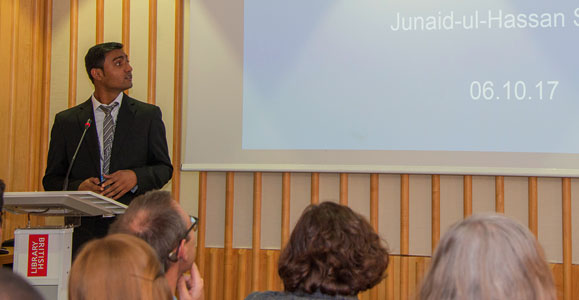
First ever Chevening British Library fellows showcase their research

4 tips for managing your mental health when moving to a new country
How to weather the ups and downs of studying away from home.