
Building climate solutions with a Chevening Fellowship
Siddharth Sinha’s journey spans engineering, government, and technology, culminating in the Chevening CRISP Fellowship at Oxford.
From engineering to the centre of climate policy
Before Siddharth Sinha’s Chevening CRISP Fellowship at the University of Oxford, he had already built a career across engineering, consulting, and government, focusing on creating large-scale change.
‘I studied to be an electrical engineer, which led me into strategy consulting. But I always believed that if you wanted to drive real change at the macro-level, you needed to be where the big decisions were made – the government.’
That belief guided him from the London School of Economics to India’s National Institution for Transforming India (NTII Aatog), where he worked on major climate initiatives, including the National EV Mission and India’s COP26 strategy.
He later contributed to the Green Development Pact while working with India’s G20 Secretariat and later moved to Google, where he helped build an AI powered air quality system now used in 150 cities across India and Brazil.
Space to think and learn from global experts
‘What the CRISP Fellowship at Oxford gave me was something genuinely hard to find in a demanding career: uninterrupted time to read, write, and think.
‘Beyond that, it gave me access to some of the top voices in the world on climate, technology, and policy… people whose work I had been reading for years and could now sit across the table from.’
These conversations helped him sharpen ideas he had already started developing, particularly around how AI and systems thinking can improve climate and energy decisions.
Using AI to improve climate finance
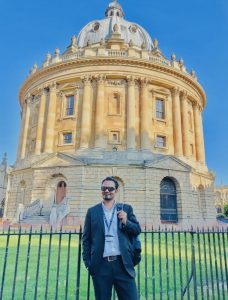
During his time at St Cross College, Siddharth worked on a climate finance project, guided by mentors. The project explored how AI can help make better decisions about where to invest money for climate action.
‘The problem at its core is information asymmetry. A dollar invested in energy is not equal everywhere… Putting a solar panel in a district in Burkina Faso that has schools, but no electricity does not just bring power. It improves educational outcomes, health, and economic opportunity all at once.’
By using AI to better understand data, decision-makers can direct funding to places where it can make the biggest difference.
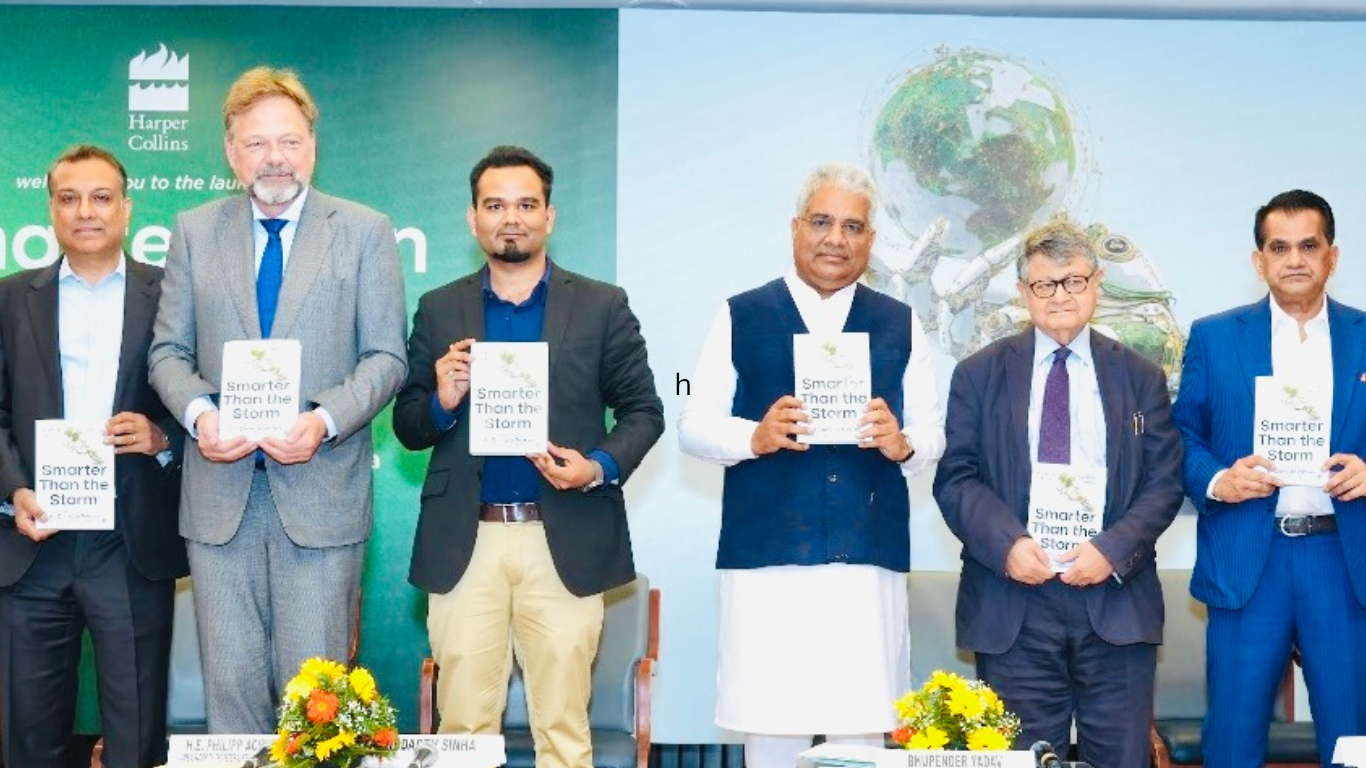
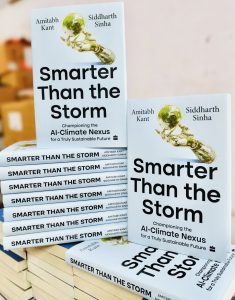
This perspective directly informed later chapters of his co-authored book, Smarter Than the Storm, which explores the relationship between AI and Climate and has now been published globally by Harper Collins.
Systems thinking and breakthrough conversations
Siddharth’s fellowship opened the doors to new ideas and collaborations across disciplines. He was able to engage with experts in AI governance, climate policy, geopolitics, and sustainable development.
A defining influence came through Professor Malcolm McCulloh from the University of Oxford’s Department of Engineering Science, whose work shaped his approach to system design.
‘We brainstormed for hours and it genuinely felt like a mutual eureka moment.’
This collaboration helped strengthen a key idea in Siddharth’s work: climate, AI, energy, and policy cannot be treated as separate systems.
By using systems thinking, it becomes easier to see how these areas influence each other, find the most effective points to intervene, and design solutions that are strong and long-lasting.
‘I have always worked at the intersection of subjects rather than within a single discipline, and Oxford is one of the few places in the world where that is an advantage rather than an oddity.’
Turning ideas into action
After completing his fellowship, Siddharth joined Greenko Group and AM Green, where he is currently Associate Vice President, working across one of the world’s largest integrated clean energy platforms.
‘The intersection of clean energy, green molecules, and sovereign AI is exactly what my fellowship, my project work, and book were all about.’
He is currently working on renewable energy, green hydrogen, and AI infrastructure, putting many of the ideas he developed at Oxford into practice on a large scale.
Looking ahead
For Siddharth, the CRISP Fellowship was more than an academic experience – it continues to influence his work today. The knowledge and networks he gained are still shaping how he approaches global challenges in climate, energy, and technology.
‘The networks and thinking from the fellowship continue to feed directly into many things I do… I’m grateful to the FCDO, Chevening, and St Cross College, for all that they have enabled for me.’
Looking forward, he hopes to deepen his work at the intersection of clean energy systems, AI infrastructure, and policy design, including continued collaboration with colleagues at Oxford’s Department of Engineering Science.